

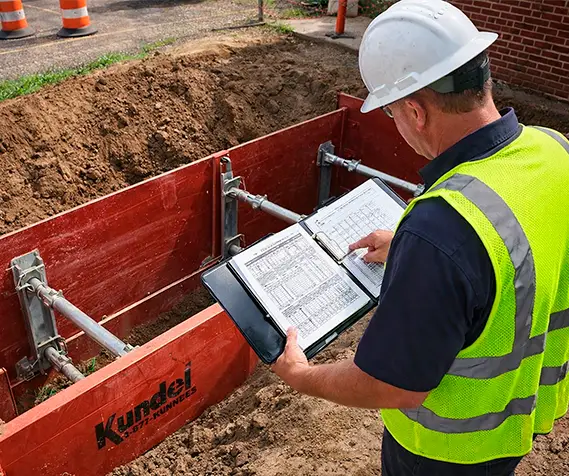
For many crews, tabulated data is where confidence disappears.
The trench is open, the shore is on-site, and someone is staring at a chart trying to make sure the setup is right. But this is not just paperwork. If you are using aluminum hydraulic shoring, tabulated data is part of staying compliant and part of keeping crews safe.
Why tabulated data matters
OSHA allows protective systems to be used based on manufacturer tabulated data, but that system has to be installed and used according to the manufacturer’s specifications, recommendations, and limits. That data also needs to be available at the jobsite.
That means tabulated data is not extra. It is the rulebook for how the system can actually be used.
KUNDEL includes manuals and tabulated data with its Hydraulic Shoring Jacks, which is exactly how this information should be treated: as part of the system, not an afterthought.
The biggest mistake: assuming any OSHA chart will work
This is where crews get into trouble.
OSHA’s appendix charts are not a catch-all for every hydraulic shoring setup. If you are using a manufacturer-specific system, you need that manufacturer’s data on-site and you need to follow it.
So if your crew is using a KUNDEL TrenchJack or a HydroJack, do not rely on a generic chart or an old reference from another project. Use the tabulated data for that exact system.
A quick note on soil confusion
OSHA uses the standard soil classifications: Type A, Type B, and Type C.
But in the field, contractors often run into extra terms, job-specific notes, or manufacturer-specific conditions that do not fit neatly into a basic OSHA chart. That is where people start guessing, and that is exactly what tabulated data is meant to prevent.
If the system depends on manufacturer-specific data, the right move is simple: use the manufacturer’s chart, not assumptions.
How to read the chart
Reading hydraulic shoring tabulated data gets easier when you stop overthinking it.
- Start with trench depth
Use the actual trench depth, not the planned depth. - Confirm soil type
The competent person needs to classify the soil correctly before choosing the setup. - Match the system to the chart
Make sure you are using the chart for the exact product on-site. - Check cylinder spacing
This is often the key detail. The chart may allow different setups depending on spacing, depth, and width. - Check whether sheeting is needed
Some conditions call for plywood, FinForm, or other sheeting behind the rails to control sloughing between supports.
When FinForm or sheeting matters
Hydraulic shores do not always provide continuous wall coverage on their own. In less stable soils, material can break loose between support points even if the shores are installed correctly.
That is why sheeting behind the rails matters. It helps control loose soil and gives the trench wall more continuous support where needed.
This is also why tabulated data matters so much. It helps answer not just how to place the jacks, but whether the system needs additional support to match the conditions.
The simplest compliance miss
One of the most avoidable mistakes is not having the right data on-site.
If the system is being used under manufacturer tabulated data, that data needs to be available at the jobsite. Not in the office. Not buried in email. On-site.
That is a basic compliance step, but it is one that still gets missed.
Bottom line
Tabulated data is there to make trench protection specific.
It tells crews how the system can be used, what spacing is allowed, and when extra measures like sheeting may be required. For aluminum hydraulic shoring, that is not optional information. It is what helps the competent person make the right call before anyone entes the trench.
Ensure your site is compliant. Review the tabulated data for KUNDEL Hydraulic Shoring before the trench opens.