


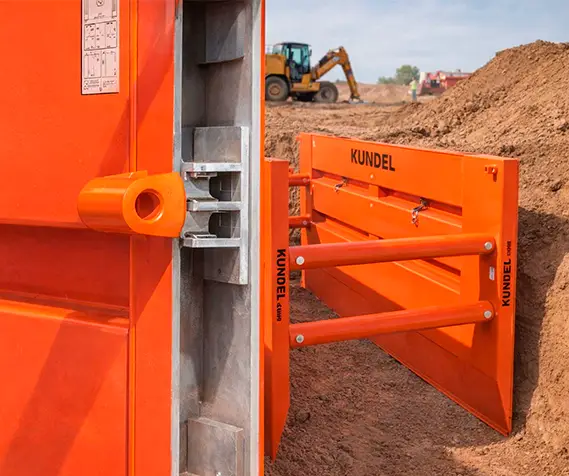
That is the part taking repeated force from dragging, resetting, loading, and everyday production use. It is also the area most likely to crack when the design relies on a welded socket. For equipment managers and maintenance leads, that matters because once the socket starts failing, the trench box becomes a repair pattern instead of a dependable asset.
The spreader socket is the weak link
If you have dealt with torn sockets before, you already know this is not a small issue.
The spreader socket carries force at one of the highest-stress points on the box. When that box is dragged repeatedly across a jobsite, the load is not applied once. It is applied over and over again. That repeated stress is what causes fatigue.
This is why trench box spreader sockets deserve more attention during purchasing. It is also why many trench shield repairs keep happening in the same place.
Why welded sockets fail sooner
A welded socket can do the job for a while. The problem is what happens over time.
Welded areas create a more concentrated stress point. Under cyclic loading, especially from dragging, that concentrated stress can turn into cracking. Once cracking starts, repairs are usually not a one-time event. The box may go back into service, but the same area remains the most vulnerable part of the structure.
That leads to a familiar cycle:
Repair, return, repeat
- Crack at the socket
- Pull the box for welding
- Put it back in the field
- Watch the same area fail again later
That is where repair costs start building quietly. Not just welding costs, but downtime, lost availability, and disruption to production.
The Titan solution: cast steel sockets
The KUNDEL Titan was designed to solve that exact problem.
Instead of a standard welded socket, it uses heavy-duty all-steel cast sockets. That means there is significantly more material at the stress point. More importantly, the casting allows force to move through the socket more evenly instead of concentrating load at a welded connection.
Why that matters in the field
A cast socket helps deliver:
- better load distribution
- less fatigue at the connection point
- fewer socket-related repairs
- longer service life
- stronger overall trench box durability
This is one of the most important KUNDEL Titan features because it directly addresses the failure point that causes so much downtime in the field.
The real cost is ownership, not purchase price
A lower upfront price can look attractive until the box starts needing regular repair.
That is when the real math shows up.
The cost of welded socket designs
- recurring trench shield repair
- labor for welding and handling
- lost production while the box is out of service
- reduced confidence in equipment performance
- shorter usable life of the asset
For maintenance teams, that means the cheaper trench box can become the more expensive one over time.
A trench box built with cast sockets changes that equation. It is designed to reduce maintenance at the point most likely to fail first.
This is also a safety issue
A torn socket is not just a maintenance problem.
In deep trench applications, it is a structural concern. The spreader socket is a critical connection point. When that area fails, the consequences are much more erious than surface-level damage.
For crews working in demanding trench conditions, durability is not just about getting more years from the equipment. It is about reducing failure risk in the trench itself.
What buyers should be asking
When comparing heavy duty trench box parts and trench box designs, the right question is not just, “How much does it cost?”
It is:
Where will this box fail first?
If the answer is the spreader socket, then the socket design should drive the buying decision.
Welded sockets often create a repair cycle. Cast sockets are built to resist it.
That is the difference between buying a trench box that lasts and buying one that keeps coming back for repair.
Bottom line
The spreader socket tells you a lot about how a trench box will perform over time.
If that connection depends on a welded design, the box is more likely to experience cracking and fatigue under repeated loading. If it is built with a heavy-duty cast steel socket, the load is distributed better, the stress point is stronger, and the box is better equipped for long-term use.
Request a quote on Titan Series.