


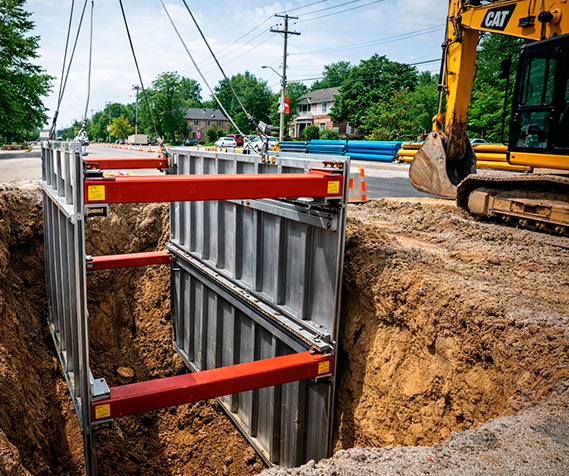
Urban excavation has a habit of humbling the wrong equipment.
A trench can look manageable on the print, then turn complicated the second the street narrows, utilities stack up, or the crew loses room to work. That is why the best shoring system for city jobs is not always the biggest or the most familiar. It is the one that keeps working when the trench stops cooperating.
Here is the checklist that matters.
1. It should adapt without slowing the day down
In urban work, the trench changes. Widths drift. Access tightens. The clean, straight run you planned at 7 a.m. can look very different by noon.
That is where modular hydraulic shoring earns its keep. HydroJack is positioned as a modular safety shoring system designed to increase productivity in the trench, while the broader hydraulic shoring jack line emphasizes clean connections, adjustable setups, certified hydraulic power, and efficient operation that reduces production delays.
2. It should work around utilities, not create a second problem
This is where urban excavation gets real.
Existing lines are not a side note in city work. They are often the job. If the system cannot handle utility congestion, the crew ends up building workarounds instead of making progress. The V-Panel is designed to allow vertical movement in the trench so crews can work around preexisting utility configurations, and aluminum trench boxes are positioned to shore around multiple existing utilities.
3. It should still be easy to use after the trench gets ugly
A lot of systems sound great before the mud shows up.
The real test is what happens after dirt starts packing into connections and every adjustment takes more effort than it should. That is why the Big-Block Standoff matters. KUNDEL explains that traditional small-block connections can create more resistance when dirt falls in, while its big-block design lets dirt fall through and helps keep the system running smoothly.
4. It should fit the excavation, not just the product category
A trench box can absolutely be the right answer for a straight, predictable run. But city jobs are rarely that polite.
When the trench is tighter, more variable, or loaded with utility conflict, more adaptable options start to make sense. Systems like TrenchJack, HydroShore, and the TrenShore Series are all framed around lightweight handling, versatility, and productivity in the trench.
5. It should help productivity, not just protection
Safety is the baseline. Productivity is where the better systems separate themselves.
On KUNDEL’s product pages, the recurring message is not just worker protection. It is cleaner operation, fewer production delays, easy transportation, modular design, and features like safety finger guards and optional TrenchLock that help the system work better in the field. For crews under pressure to finish the cut and move on, that is not extra. That is the point.
Urban excavation already comes with enough friction. The shoring system should remove some of it.
Explore hydraulic shoring jacks, HydroJack, TrenchJack, TrenShore Series, and V-Panel for urban jobs that demand more than a one-size-fits-all answer.→ KUNDEL