


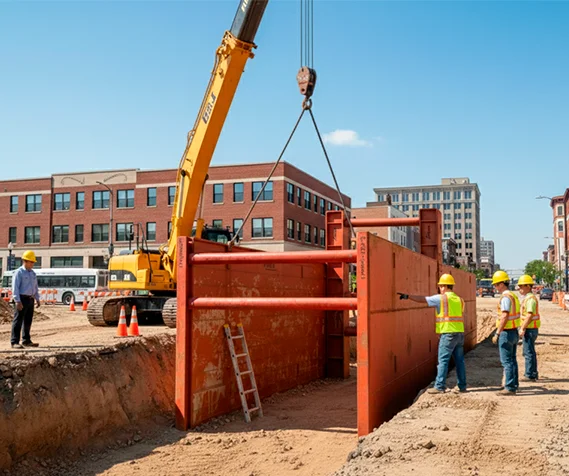
Why it matters: OSHA requires protection systems for trenches 5′ deep or more, and job-built shields without engineering are not acceptable.And when you choose a shielding solution like the KUNDEL Titan Series, those features become part of what you check before the crew goes in.
The Trench Safety Checklist
If everyone goes home, this is what gets verified.
1. Shielding Is Installed Before Entry
No one enters the trench until a proper shielding system is in place. If the trench is five feet deep or more, protection is required.
Trenching and excavation collapses have led to hundreds of deaths over the past two decades, with studies showing an average of about 25 fatalities a year from trench-related incidents in the U.S., many of which occurred in unprotected or improperly protected trenches.
Workers often have little to no time to react when walls give way, which is why protection must be installed before any work begins.
2. The Shield Is Built for the Load
Trench boxes must be structurally sound and engineered for real-world conditions.
That means:
- Panels free from visible damage or deformation
- Heavy-duty spreader systems securely locked in place
- Connection points designed to resist tear-out under pressure
3. Knife Edge Fully Engaged
A properly designed knife edge allows the trench box to move smoothly with the excavation while maintaining protection.
Before entry:
- The knife edge is seated correctly
- The box is positioned to move forward without compromising stability
Quote to Live By: If the box can’t advance safely, the work shouldn’t advance either.
4. Safe Lifting and Rigging Practices
Trench boxes should be lifted using designated lift points, not improvised connections.
Before installation:
- Rigging is attached to recessed lift points
- Sling angles are controlled to reduce stress
- Equipment operators and ground crews are aligned on the lift plan
5. Shield Size Matches the Trench
The box must match the depth, width, and soil conditions of the excavation.
That includes:
- Correct height for trench depth
- Proper length for pipe or utility installation
- Verification by a competent person that the shield is appropriate for the soil type
6. Clear and Stable Egress
Workers must always have a safe way out.
Before entry:
- Ladders are placed within required spacing
- Access points are not blocked by equipment or materials
- Entry and exit routes remain clear throughout the shift
Always ask yourself: Can I exit this trench box quickly?
7. Spoil Piles Kept Back
Excavated material adds pressure to trench walls.
That’s why:
- Spoil piles are kept at least two feet from the edge
- Heavy equipment is positioned to avoid surcharge loads
Did you know? Collapse risk doesn’t always come from below. Often it comes from what’s stacked above.
8. Daily Review by a Competent Person
Conditions change. Soil shifts. Weather moves in.
Every day:
- The trench is inspected before work begins
- Hazards are identified and corrected immediately
- Work pauses if conditions become unsafe
“We did careful research on what could really help us in the field, and the V Panel system turned out to be the solution to all of our challenges. It’s truly the Swiss Army Knife of shoring.”
Kevin Smith
D.N. Higgins
https://www.dnhiggins.com/
This Is the KUNDEL Standard
Finishing the job matters.
Meeting the schedule matters.
But none of it matters more than this.
Everyone goes home.
We work in this industry. We talk to contractors, operators, and safety managers every day. We study incident reports. We review OSHA findings. We see the same patterns repeat when protection is delayed, improvised, or treated as secondary to production.
This checklist exists because trench failures do not come with warnings, and the margin for error is measured in seconds. It reflects what we believe trench safety should look like when it is done intentionally, consistently, and without compromise.
This is not about doing the minimum required to get through an inspection. It is about setting a standard that holds up on real jobsites, under real pressure, with real people in the trench.
That is the KUNDEL standard.