


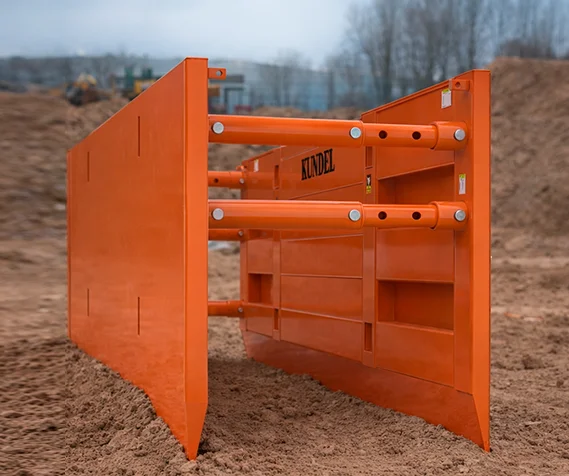
On a production pipe job, the trench box should not slow the crew down.
The cycle is simple: excavate, lay pipe, pull the box ahead, backfill, and repeat. But when crews are dragging a trench box that is not designed for forward movement, every pull creates more resistance, more strain on the machine, and more lost time in the trench.
That is exactly why the KUNDEL Titan Series was built for high-production trench work.
The Problem with Standard Boxes in Drag-Ahead Work
The drag-ahead method is one of the fastest ways to keep pipe installation moving, but it is also one of the toughest on equipment.
As the box is pulled forward, soil drag works against the excavator and increases stress on the box itself. That friction slows the cycle, strains the rigging, and wears down structural connection points over time.
For superintendents and project managers, that means fewer cycles per day and less pipe in the ground.
Friction Is a Production Problem
When a box drags hard, the delay does not stop at the pull. It disrupts the entire installation rhythm.
A few extra minutes on each move may not sound like much, but across a long run, those minutes can quietly stretch into days on the schedule. That is why pipe laying productivity is not just about labor or equipment count. It is also about how efficiently the trench box moves.
How KUNDEL Titan Boxes Reduce Resistance
The advantage of the Titan Series trench box starts at the leading edge.
The 18″ Easy Glide Knife Edge
KUNDEL’s 18″ Easy Glide Knife Edge is engineered to cut through soil more efficiently during forward pulls, helping reduce resistance as the box moves ahead. KUNDEL describes this 18-inch tapered knife edge as standard on every Titan Series trench box and specifically positions it around drag-ahead movement through the soil.
Instead of forcing the excavator to fight through every drag, the knife edge helps the box move more cleanly through the trench. The result is a smoother cycle, less wasted motion, and better daily output for crews focused on production.
That is what makes the Titan a smarter choice for contractors looking for better excavating efficiency techniques in the field.
How the Titan Knife Edge Compares
Not every trench box manufacturer approaches forward movement the same way.
Some trench shield manufacturers offer knife-edge designs on only certain models or sizes. For example, ESC states that reinforced knife-edge bottoms are standard on its 8-foot and 10-foot shields, while its 4-foot and 6-foot shields come standard with flat bottoms unless a knife edge is requested. TrenchTech also promotes a strong knife-edge design as a feature of its steel trench boxes.
Other manufacturers, such as Allen Trench Safety, emphasize lightweight aluminum construction, transportability, and quick setup rather than a drag-ahead-focused knife-edge message.
KUNDEL’s difference is not simply that it offers a knife edge. It is that the Titan Series makes the 18″ Easy Glide Knife Edge a standard feature across the line and ties that design directly to drag-ahead trenching performance. For contractors trying to improve cycle time on production pipe jobs, that means the movement advantage is built in, not limited to select configurations.
Built to Handle the Abuse of Repeated Pulls
Drag-ahead work does not just test movement. It tests durability.
Repeated forward pulls put serious stress on the spreader socket area, which is where weaker welded designs often start to show wear. KUNDEL Titan boxes are built with Cast Sockets, giving crews a stronger design for repeated production use. KUNDEL also markets the Titan Series around durability and jobsite performance in demanding trench conditions.
Strength Where It Matters Most
A trench box built for drag-ahead work needs to do two things well: move efficiently and hold up under pressure.
That combination is what makes the Titan Series lineup valuable on demanding utility projects. It is engineered for the real conditions crews face when production is the priority.
More Cycles Per Day Start with the Right Box
When the box moves easier, the job moves faster.
Less friction means smoother pulls. Smoother pulls mean faster cycles. Faster cycles mean more pipe installed by the end of the day.
For project managers trying to protect schedule and output, that is where the return shows up.
Stop Fighting Friction
If your crew uses the drag-ahead method, your trench box should be helping production, not hurting it.
Increase your daily pipe footage with the KUNDEL Titan Series.