


Manual lifting problems rarely show up as one clean line item. They spread across workers’ compensation claims, absenteeism, turnover, slowed production, product damage, rework, and labor inefficiency.
That is why lift assist devices for manufacturing should not be viewed as safety equipment alone. For plant managers, EHS leaders, and operations teams, they are an investment in safer work, stronger throughput, and more consistent production.
The strongest business case connects three things leadership already cares about: injury reduction, productivity improvement, and cost control.
Why Lift Assist ROI Matters
Labor shortages, aging workforces, tighter production schedules, and rising safety expectations all make repetitive manual lifting harder to ignore.
When operators repeatedly lift, rotate, position, or carry awkward parts by hand, the cost goes beyond physical strain. Fatigue can slow cycle times. Poor handling can damage product. Injuries can create lost time, overtime, and staffing disruption.
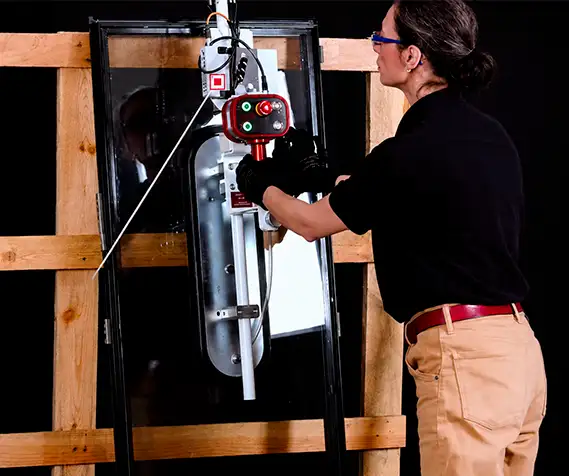
A lift assist device helps reduce that exposure by transferring the load away from the operator and into a controlled mechanical system. Instead of manually lifting the weight, the operator guides the part with less force, more control, and greater consistency.
For workstations that need localized lifting coverage, zero gravity lift-assist jib arms can help operators handle repetitive material movement with smoother control and less physical strain.
What to Include in a Lift Assist ROI Case
A strong lift assist ROI case should include both direct and indirect savings.
Direct savings are usually easier to calculate because they are tied to injury costs and claim history. Indirect savings are often where the real operational value shows up.
Direct Cost Savings
Start with the costs tied to injury risk and manual handling strain, including:
- Workers’ compensation claims
- Medical costs
- Lost-time incidents
- Restricted-duty assignments
- Overtime coverage
- Temporary labor
- Supervisor and administrative time
These numbers help leadership understand that manual lifting already carries a cost, even before equipment is purchased.
Indirect Cost Savings
Indirect costs can be just as important. A lift assist device may also help reduce:
- Production slowdowns from fatigue
- Two-person lifts that tie up labor
- Product damage from drops or awkward handling
- Rework and scrap
- Training costs tied to turnover
- Bottlenecks at high-frequency workstations
This is where the business case becomes stronger. The investment is not only about preventing injuries. It is about improving how the work gets done.
Step 1: Identify the Highest-Risk Manual Lifting Tasks
Do not start with the equipment. Start with the work.
Look for tasks where operators are repeatedly lifting heavy, awkward, fragile, or hard-to-grip parts. Prioritize stations where the team already sees injuries, near misses, fatigue complaints, slowdowns, quality issues, or two-person lifts.
In many cases, the right solution depends on both the lift method and the structure supporting it. Some facilities may need a dedicated lift assist device at one station, while others may benefit from pairing lift assist equipment with jib cranes or overhead bridge cranes to expand the usable work area.
What to Document
For each task, collect:
- Load weight
- Lift frequency
- Lift height
- Travel distance
- Rotation or positioning requirements
- Current number of operators needed
- Current cycle time
- Injury or near-miss history
- Scrap or rework tied to handling
- Any surface protection or quality concerns
This gives leadership a clear view of the current-state problem. It also gives the supplier better information for designing the right lift assist solution around the actual workstation, load, and workflow.
Step 2: Estimate Injury Cost Exposure
Injury reduction is often the first piece of the ROI case. Manual material handling can contribute to strains, overexertion injuries, back injuries, and fatigue-related incidents.
To make the case credible, avoid vague claims like “this will improve safety.” Instead, connect the investment to measurable exposure.
For example:
“This workstation requires repeated manual lifting throughout the shift and has a history of strain complaints. A lift assist device would reduce the operator’s physical load, support safer handling, and create a documented engineering control for a known risk.”
That language is stronger than simply saying the equipment will make the job easier. It frames lift assist as a risk-reduction strategy with operational value.
Step 3: Calculate Productivity Gains
Productivity savings often help move a lift assist project from “safety request” to “operations investment.”
If a device saves even a few seconds per lift, the value can add up quickly across hundreds or thousands of cycles.
Simple Productivity Formula
Annual productivity savings =
seconds saved per cycle × cycles per shift × shifts per year ÷ 3,600 × loaded labor rate
For example, if a lift assist device saves 8 seconds per lift, the task runs 250 cycles per shift, the workstation operates 250 shifts per year, and loaded labor cost is $38 per hour:
8 × 250 × 250 ÷ 3,600 × $38 = $5,277.78 per year
That is only the time savings. It does not include reduced injuries, fewer two-person lifts, less rework, or improved consistency across shifts.
Add the Two-Person Lift Factor
If the current process requires two operators for one lift, the ROI case becomes even stronger.
A lift assist device may allow the same task to be completed safely by one trained operator, freeing the second person for higher-value work elsewhere in the facility.
The point is not always to eliminate labor. More often, it is to stop tying up two people for a task that should not require two people in the first place.
Step 4: Add Quality Savings
Manual handling can create quality problems that are easy to mislabel as operator error.
Drops, dents, scratches, coating damage, misalignment, and surface defects often happen because the part is difficult to lift, grip, rotate, or place consistently by hand.
A lift assist device can improve control during the pick, movement, and placement of the part. For applications where part shape, surface finish, or contact points matter, custom grippers can be engineered around the actual load instead of forcing operators to work around the limitations of a standard lifting tool.
Simple Quality Formula
Annual quality savings =
current annual scrap or rework cost from handling defects × expected reduction percentage
For example, if handling-related rework costs $40,000 per year and the team expects a conservative 25% reduction:
$40,000 × 25% = $10,000 per year
This helps show that lift assist protects both the worker and the product.
Step 5: Calculate Payback Period
Once the savings are estimated, calculate the payback period.
Payback Formula
Payback period = total lift assist investment ÷ annual savings
Annual savings may include injury reduction, productivity gains, quality improvements, reduced overtime, and reduced dependency on two-person lifts.
For example, if a lift assist system costs $48,000 and estimated annual savings are $40,000:
$48,000 ÷ $40,000 = 1.2 years
That gives an estimated payback of about 14 to 15 months.
The actual number will vary by facility, application, lift frequency, injury history, and product value. The key is to show the math clearly and use conservative assumptions that leadership can trust.
What Leadership Needs to See
A lift assist business case does not need to be overly complicated. In fact, the best internal pitch is usually simple and specific.
Include five key pieces:
The Problem
What task is creating risk, delay, quality issues, or staffing strain?
The Current Cost
What are the estimated costs tied to injuries, downtime, inefficiency, rework, or two-person handling?
The Proposed Solution
What type of lift assist device is being considered, and how will it change the way the task is performed?
If the application requires specific part control, this is where you should identify whether the job needs a hook, vacuum, magnetic, or mechanical gripping approach. KUNDEL’s end effectors are designed for different material handling needs, giving engineering and operations teams a clearer path to match the tool to the task.
The Expected Return
What savings are expected, and what is the estimated payback period?
The Implementation Plan
What needs to happen next: quote, design review, installation, training, maintenance, and operator adoption?
Common Mistakes to Avoid
Only Counting Injury Savings
Safety savings matter, but they are not the whole story. Include productivity, quality, staffing, and downtime impacts when possible.
Using Overly Aggressive Assumptions
A conservative ROI model is more credible. Show the math clearly and avoid inflated savings claims.
Ignoring the Operator Experience
A lift assist device must fit the actual workflow. If it slows the operator down, blocks access, or feels awkward to use, adoption will suffer.
Treating the Gripper as an Afterthought
The end effector matters. Part shape, surface finish, weight, contamination, and allowable contact points all affect the final design.
For example, a flat, smooth panel may call for a vacuum gripper, while ferrous materials may be better suited for a magnetic gripper. Irregular or heavy parts may require a mechanical gripper designed around the part geometry and handling requirements.
Forgetting Maintenance and Training
Include operator training, inspection routines, maintenance expectations, and ownership responsibilities in the implementation plan. This helps protect the investment after installation.
When Lift Assist Devices Make the Most Sense
Lift assist devices are especially valuable when a task involves:
- Repetitive lifting
- Awkward or offset loads
- Poor handholds
- Two-person lifts
- High-value or damage-sensitive parts
- Operator fatigue
- Repeated strain complaints
- Handling-related scrap or rework
- Bottlenecks at individual workstations
These are the applications where the safety and operational returns tend to stack together.
Final Takeaway
A lift assist device should not be justified as a safety expense alone. It should be evaluated as an engineering control that protects people, product quality, and production capacity.
The best ROI case shows the cost of the current manual process, estimates the value of reducing that exposure, and gives leadership a practical payback period they can trust.
Manual lifting has a cost whether it is measured or not. A strong lift assist ROI framework brings that cost into the open and gives plant managers a clear path to reduce it.
Ready to reduce manual lifting exposure and improve workstation efficiency? Explore KUNDEL’s lift assist devices for manufacturing and start building a solution around your actual load, workflow, and production goals.