


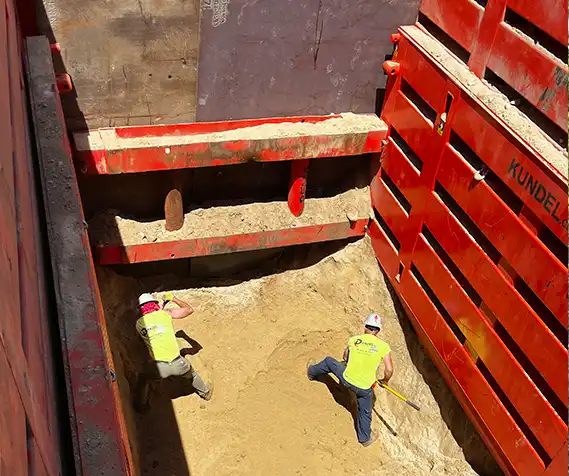
Deep trench work does not reward shortcuts.
When excavations reach 16, 20, or more feet deep, crews often need to stack trench boxes to create a protected work zone for sewer, utility, and heavy civil applications. On paper, the concept is simple: place one trench shield on top of another to extend protected depth.
In the field, it is more demanding.
Stacking trench boxes requires careful alignment, secure connections, verified depth ratings, and a lift plan that accounts for the total weight of the stacked system. If any of those details are missed, the risk increases quickly.
Important: Under OSHA requirements, trenches 20 feet deep or greater require a protective system designed by a registered professional engineer. The complete stacked configuration must also comply with all applicable manufacturer specifications, recommendations, limitations, and written tabulated data.
Why Stacking Trench Boxes Requires Extra Planning
A standard 8-foot trench box may not provide enough protected height for deeper excavations. Stacking two boxes can help crews reach the required protective depth, but the system has to be treated as one engineered assembly.
Before stacking trench shields, crews should verify:
- Trench depth and soil conditions
- Manufacturer tabulated data
- Compatibility between upper and lower boxes
- Approved stacking pins or connection points
- Total system weight
- Excavator or crane lift capacity
- Surcharge loads from nearby equipment, spoil piles, or traffic
One of the biggest mistakes is assuming that stacking two trench boxes combines or doubles their individual depth ratings. It does not. The complete stacked configuration must be expressly permitted by the manufacturer’s written tabulated data and evaluated for the actual excavation depth, soil classification, box and spreader configuration, surcharge loads, and site conditions.
For deep trench shoring, the question is not simply, “Can these boxes be stacked?” It is, “Is this complete stacked configuration approved, properly connected, and suitable for the conditions of this excavation?”
The Hazard: Unsafe Pinning and Fall Exposure
One of the most overlooked risks in stacked trench box assembly is how the connection gets made.
On some trench shield systems, workers may be forced into awkward positions to align boxes and insert stacking pins. In the worst cases, crews may climb on top of boxes or work from exposed edges to secure the connection.
That creates a serious fall hazard before the crew ever begins work inside the trench.
This is where equipment design matters.
The KUNDEL Titan Series trench box includes internal stacking points designed to provide more controlled access to the stacking connections. Depending on the approved configuration and manufacturer instructions, connections may be completed from ground level before lifting or from a protected position while the shields are fully supported and stationary.
This design can help reduce the need for workers to climb onto exposed box edges during assembly. Employees must never remain inside a shield while it is being installed, removed, or moved vertically.
Best Practices for Stacking Trench Boxes
Stacking trench boxes should always follow the manufacturer’s instructions and site-specific safety requirements. At a practical level, crews should focus on five core areas.
1. Confirm the Depth Rating of the Full Stack
Depth ratings are not decorative numbers in a brochure. They determine whether the protective system is appropriate for the trench.
Before entry, verify the stacked configuration against the manufacturer’s tabulated data. This should include trench depth, soil classification, box size, spreader configuration, and any surcharge conditions near the excavation.
For deeper cuts, do not rely on assumptions from past projects. Soil, depth, water, and nearby loads can change the answer.
2. Use Approved Stacking Connections
Only use manufacturer-approved stacking pins, sockets, and connection points. Improvised hardware can create alignment problems, connection failure, and inspection issues.
The connection between boxes has to control movement during lifting, placement, use, and removal. If the boxes can shift, twist, or separate, the protective system is compromised.
3. Build a Real Lift Plan
A double-stack lift is a heavier and more complex pick than a single trench box.
Before lifting, confirm:
- Total box and spreader weight
- Machine lifting capacity at the required radius
- Rigging capacity
- Lifting point condition
- Ground stability for the excavator or crane
- Clear communication between the operator, signal person, and ground crew
No employee should be permitted beneath a suspended load or inside a shield while it is being installed, removed, or moved vertically. During lifting, placement, movement, and removal, all workers must remain clear of the suspended load, the shield, and the equipment’s operating and swing areas.
4. Watch the Alignment
Boxes need to sit square, stable, and properly connected. Poor alignment can make stacking pins difficult to install, create uneven loading, or cause the system to bind during removal.
Crews should inspect the stack before use and after every movement. Deep trench work often requires repositioning as pipe installation progresses, so inspection is not a one-time box-checking exercise. It must continue throughout the job under the direction of the competent person.
5. Control the Area Around the Trench
Deep trench safety is not only about the shield. Conditions around the excavation matter too.
Keep excavated material and any equipment that could fall or roll into the excavation at least 2 feet (0.61 m) from the edge, unless retaining devices or another compliant method provide equivalent protection.
Heavy equipment, spoil piles, and traffic can also create surcharge loads that increase pressure on the trench walls. Their position must be evaluated as part of the site-specific protective-system plan and the applicable tabulated data.
For heavy production work, review whether a heavier-duty solution, such as the Titan Series trench shield, is appropriate for the excavation depth, equipment, soil conditions, and production requirements.
6. Require Competent-Person Inspections
A competent person must inspect the excavation, adjacent areas, and the complete protective system before work begins and as needed throughout the shift. Additional inspections are required after rainstorms or any other event that could increase the hazard.
If the inspection identifies signs of a possible cave-in, protective-system failure, hazardous atmospheres, water accumulation, or other unsafe conditions, exposed employees must leave the hazardous area until the necessary precautions have been taken.
Why Titan Series Features Matter in Deep Trench Work
Heavy civil crews need trench shields that support safety without slowing down production. The Titan Series is designed for demanding excavation environments where durability, stacking, and jobsite efficiency matter.
For deep trench applications, key Titan Series advantages include:
- Internal stacking points for safer assembly
- Heavy-duty construction for demanding excavation work
- Field-ready durability for sewer, utility, and heavy civil projects
- Compatibility with deep trench shielding workflows
- Design features that help crews work more efficiently in high-production environments
In deep excavations, small design details can have a significant effect on worker exposure and assembly efficiency. Internal stacking points can provide more controlled access to stacking connections and may reduce the need for workers to climb onto exposed box edges, provided that the approved manufacturer instructions and site-specific safety procedures are followed.
Go Deep Without Adding Unnecessary Risk
Stacking trench boxes is sometimes necessary for deep excavation work, but it should never be treated as routine.
A safe stacking operation starts before the first lift: have the excavation evaluated by a competent person, verify that the complete stacked configuration is covered by the applicable manufacturer data or engineering design, use only approved connections, confirm the lift and rigging plan, and keep workers clear of suspended loads and moving shields.
For contractors managing deep trench shoring, the goal is simple: protect the crew, maintain production, and use equipment built for the depth of the job.
Go deep with equipment designed for demanding excavation work. Explore the KUNDEL Titan Series and its internal stacking-point design for more controlled trench box assembly.
Safety notice: This article provides general information only and does not replace OSHA requirements, manufacturer instructions, site-specific evaluation by a competent person, or a protective-system design prepared by a registered professional engineer when required.