


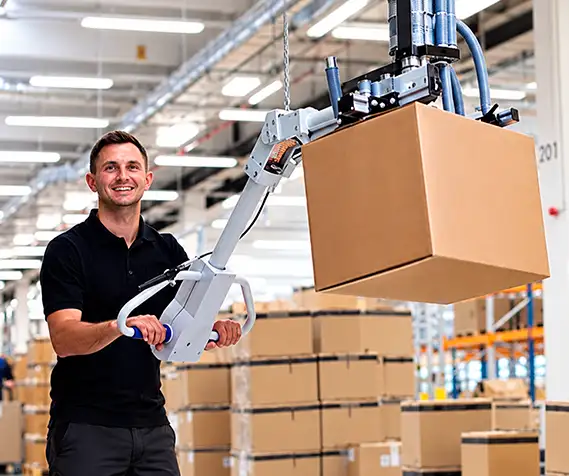
A lifting injury does not stop costing a manufacturer when the medical claim is paid.
Lost production time, overtime, temporary labor, retraining, administrative work, and future insurance costs can all add to the financial impact.
That is why ergonomic lift assist should be viewed as more than a safety upgrade.
In repetitive manufacturing tasks like feeding machines, loading fixtures, moving parts between processes, and high-frequency pick-and-place work, lift assist devices can reduce the physical load on the operator while keeping the worker in control of the movement.
How EMR Can Affect Workers’ Comp Costs
Many employers have an Experience Modification Rate, or EMR, that compares their workers’ compensation loss history with expected losses for similar businesses.
Claims can influence that rating for multiple years, which means one serious lifting injury can create a longer financial impact than the original claim suggests.
For manufacturers with recurring manual-handling tasks, reducing those injuries can become part of a broader risk-management strategy.
The Real Cost of a Lifting Injury
The true cost of a back strain or other manual-handling injury can include:
- Medical treatment
- Lost-time wages
- Overtime
- Temporary labor
- Retraining
- Production delays
- Administrative time
- Future insurance impact
That makes the financial comparison bigger than equipment cost versus medical cost.
A better question is:
What does it cost to keep performing the same high-risk task the same way?
Where Lift Assist Devices Create the Most Value
Lift assist devices are especially useful where operators repeatedly lift, hold, rotate, or position heavy and awkward parts.
Common applications include:
- Feeding parts into CNC machines
- Loading and unloading presses
- Positioning components into fixtures
- Rotating parts during assembly
- Moving parts from one production step to another
- Repetitive pick-and-place work
- Handling glass, sheet metal, automotive components, crates, and machine parts
KUNDEL’s lift assist devices for manufacturing are designed around these types of applications, using zero-gravity balancers, jib arms, and custom grippers to support the weight while the operator controls the movement.
That distinction matters.
The goal is not simply to help someone lift more.
It is to reduce how much physical load that operator absorbs hundreds of times per shift.
Start With the Workstations Already Showing Risk
The highest-value lift assist opportunities are often easy to spot.
Look for workstations where:
- Operators complain about fatigue
- Two people are required for one lift
- Parts are repeatedly lifted from low bins
- Operators twist or reach while holding weight
- Feeding a machine requires awkward positioning
- Near misses or strains have already occurred
- Product damage happens during handling
KUNDEL’s article The Injury Was Already in the Workstation explains how repetitive lifting risk is often built into the workstation long before an injury becomes an incident report.
Those are the stations worth evaluating first.
Document the Risk Reduction
Installing ergonomic equipment is only part of the process.
Document what changed.
Before implementation, record:
- Part weight
- Number of lifts per shift
- Reach distance
- Operator posture
- Number of people required
- Injury and near-miss history
After implementation, track:
- Reduced manual load
- Fewer two-person lifts
- Operator feedback
- Injury trends
- Cycle-time changes
- Product damage or quality changes
This gives safety, operations, finance, and insurance teams a clear record of the problem and the engineering control used to address it.
Bring Your Insurance Broker Into the Conversation
If your facility installs lift assist equipment to reduce a known manual-handling risk, share that improvement with your broker or risk-management team.
Show them:
- The original workstation risk
- Injury or claim history
- Load weight and frequency
- The lift assist system installed
- Before-and-after ergonomic changes
- Training and inspection procedures
A lift assist installation does not automatically guarantee a lower premium, but documented hazard reduction can support a stronger underwriting and renewal conversation.
How to Calculate Lift Assist ROI
The strongest business case combines workers’ compensation risk with operational savings.
1. Review Recent Injury Costs
Look at lifting-related claims, lost time, overtime, temporary labor, and production disruption.
2. Identify High-Risk Tasks
Prioritize machine-feeding stations, repetitive lifts, awkward handling, and tasks with known injury history.
3. Calculate the Full Lift Assist Investment
Include:
- Lift assist device
- Custom gripper or end effector
- Jib or rail system if required
- Installation
- Training
- Maintenance
KUNDEL offers both zero-gravity balancers for repetitive manufacturing tasks and lift assist jib arms for floor- or wall-mounted applications.
4. Estimate Avoided Costs
Compare the investment against historical injury costs and operational improvements such as:
- Fewer two-person lifts
- Less overtime
- Faster machine loading
- Reduced product damage
- More consistent handling
For a closer look at the quality side of material handling, read The Part Passed Inspection. Then Someone Picked It Up.
5. Estimate Payback
A simple framework is:
Lift Assist Investment ÷ Estimated Annual Avoided Cost = Estimated Payback Period
For example, if a $40,000 lift assist system helps avoid an estimated $30,000 per year in injury-related and operational costs, the estimated payback is about 16 months.
The exact result will vary by application. The purpose is to give EHS, operations, HR, and finance a shared way to evaluate the investment.
Frequently Asked Questions
Can lift assist devices help reduce workers’ compensation costs?
They can support a broader risk-reduction strategy by reducing physical exposure in repetitive lifting tasks. Actual workers’ compensation pricing still depends on claim history, payroll, carrier practices, state rules, and other factors.
What manufacturing tasks are best suited for lift assist?
Machine feeding, press loading, fixture loading, assembly, repetitive pick-and-place work, and heavy or awkward part handling are common applications.
How do lift assist devices reduce injury risk?
The equipment supports the load while the operator controls direction, positioning, rotation, and placement. That reduces the amount of weight the employee repeatedly lifts or holds.
What type of lift assist system should a manufacturer use?
That depends on the part, load weight, movement path, workstation layout, and gripping method. KUNDEL offers custom grippers for lift assist systems for applications that require mechanical, vacuum, magnetic, or other specialized handling methods.
Manufacturers comparing different ergonomic approaches can also read Exoskeletons vs. Lift Assist Devices: Which Technology Actually Reduces the Load?
Explore KUNDEL Lift Assist Devices
KUNDEL engineers lift assist systems around real manufacturing applications, including machine feeding, assembly, part rotation, and precision placement.