


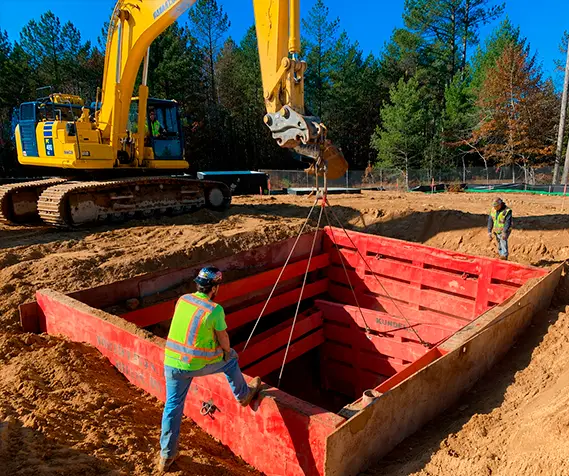
A trench box does not have one universal maximum depth.
Its allowable depth depends on soil conditions, trench depth, surcharge loads, and the manufacturer’s tabulated data. A box that can be used deeper in stable soil may have a much lower allowable depth in weaker soil.
The key question is:
How much pressure is the trench shield engineered to resist under the actual excavation conditions?
What Does a Trench Box Depth Rating Mean?
A trench box depth rating identifies how deep a specific shield configuration can be used under stated conditions.
Factors that affect the rating include:
- Soil classification
- Trench depth
- Lateral earth pressure
- Surcharge loads
- Shield size and configuration
- Manufacturer tabulated data
A published maximum depth should never be treated as a universal rating for every job.
What Is PSF in Trench Box Ratings?
PSF stands for pounds per square foot.
It describes the pressure acting against the trench shield.
As excavation depth increases, lateral soil pressure also increases.
A simplified way to think about it is:
More depth = more lateral pressure
That is why the same trench box may have different allowable depths depending on soil conditions.
Why PSF Matters
The sidewalls, spreaders, and connections of the trench shield must resist the pressure created by the surrounding soil.
Once that pressure exceeds the system’s engineered capacity, the box is outside its approved use.
How Soil Type Changes Depth Ratings
Soil classification is one of the biggest factors affecting trench box depth ratings.
Type A Soil
Type A is generally the most stable OSHA soil classification.
A trench shield may have a greater allowable depth in qualifying Type A soil.
Type B Soil
Type B is less stable than Type A, which can reduce the allowable depth of the same trench box.
Type C Soil
Type C is the least stable OSHA soil classification.
As soil stability decreases, allowable trench box depth can decrease significantly.
The box did not become weaker. The loading conditions became more demanding.
Why the Same Box Can Have Different Ratings
A trench shield may reach its maximum pressure limit much sooner in weaker soil.
For example, a box rated for approximately 20 feet under one soil condition may only be approved for around 10 feet under a more demanding condition such as C-60, depending on the manufacturer’s tabulated data.
Always use the tabulated data for the exact shield and configuration.
How Surcharge Loads Affect Trench Box Capacity
Soil is not always the only load affecting an excavation.
Additional pressure can come from:
- Excavators
- Dump trucks
- Spoil piles
- Stored pipe
- Nearby structures
- Vehicle traffic
These are surcharge loads.
Why Equipment Near the Edge Matters
Heavy equipment near the excavation can transfer additional pressure through the surrounding soil.
The trench shield may therefore be resisting:
Earth pressure + surcharge pressure
That added load can affect the allowable depth or require additional engineering.
Never Average Trench Depth
If one section of a trench is 8 feet deep and another reaches 14 feet, do not treat it as an average 11-foot trench.
Protective-system selection must account for the deepest point where the shield is being used.
A simple rule:
- Measure the deepest point.
- Classify the soil.
- Identify surcharge loads.
- Check the tabulated data.
Shorelite vs. Tuffguy Aluminum Trench Box Depth Ratings
Shorelite Series
Maximum depth: Up to 20 feet
Lightweight, modular aluminum trench shielding for utility, municipal, and repair applications.
Tuffguy Series
Maximum depth: Up to 21 feet
Aluminum trench shielding with steel components for added durability.
These are maximum listed depths, not universal working depths. Actual use depends on soil type, configuration, surcharge loads, and manufacturer tabulated data.
Explore KUNDEL Aluminum Trench Boxes.
How to Read Trench Box Tabulated Data
1. Identify the Soil Classification
Determine the actual soil type using the required field testing methods.
2. Measure the Maximum Trench Depth
Use the deepest point, not an average.
3. Confirm the Shield Configuration
Verify the model, panel size, spreaders, and any stacking arrangement.
4. Account for Surcharge Loads
Consider nearby equipment, traffic, spoil piles, and structures.
5. Match Conditions to the Manufacturer’s Data
Only use the shield within the approved limits shown in its tabulated data.
Frequently Asked Questions
What determines a trench box depth rating?
Soil classification, trench depth, shield configuration, surcharge loads, and manufacturer tabulated data all affect the allowable depth.
Does Type C soil reduce trench box capacity?
It can. Less stable soil can create more demanding loading conditions, which may reduce the allowable depth.
What does PSF mean?
PSF means pounds per square foot and describes pressure acting against the trench shield.
Can I always use the advertised maximum depth?
No. Maximum depth depends on the conditions and configuration listed in the manufacturer’s tabulated data.
Do excavators affect trench box ratings?
Yes, they can. Heavy equipment near the excavation may create additional surcharge pressure.
The Bottom Line
Trench box depth ratings are about more than one number.
The correct selection depends on:
Soil type + trench depth + surcharge loads + shield configuration + tabulated data
Match the protective system to the actual excavation conditions first.
Then use the manufacturer’s tabulated data to determine the allowable depth.
Match the Right Trench Box to the Job
Kundel offers modular aluminum trench boxes for utility, municipal, sewer, waterline, and repair applications.