

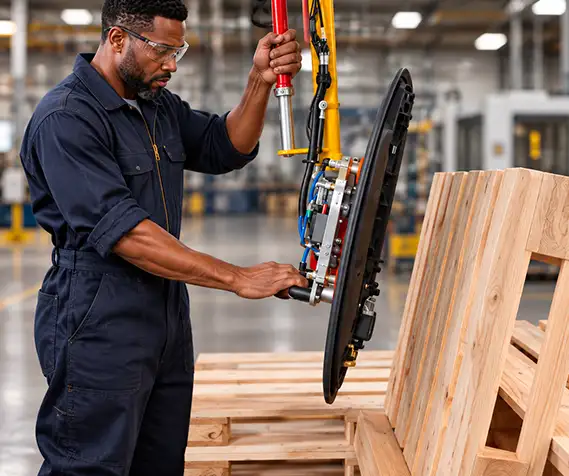
A lift assist device should do more than move a heavy part. It should make that part easier to handle, position, and transfer without slowing production.
But not every lift assist system is built for the same job.
A machine operator loading a 75-pound casting into a CNC machine has different requirements than an assembly technician positioning a fragile component.
Choosing the right equipment comes down to three decisions: configuration, capacity, and controls.
Here’s what manufacturers should consider before investing.
1. Choose the Right Lift Assist Configuration
The first question isn’t how much weight you need to lift. It’s where that weight needs to go.
Jib Crane-Mounted Lift Assist Devices
Ideal for individual workstations where operators repeatedly lift and position parts within a defined area.
Common applications include:
- CNC machine loading and unloading
- Moving castings into fixtures
- Transferring components between adjacent stations
KUNDEL’s foundationless jib cranes offer a solution for facilities adding workstation lifting capabilities without traditional poured foundations, where floor conditions permit.
Overhead Rail-Mounted Lift Assist Devices
Designed for moving components across larger production areas or between multiple workstations.
These configurations work well for assembly lines, repetitive transfers, and facilities where floor space is limited.
Fixed Workstation Lift Assist Devices
Best suited for dedicated operations requiring repetitive lifting, precise positioning, or machine feeding.
A properly configured system allows operators to guide parts into position while the equipment supports the load.
2. Determine the Correct Lifting Capacity
Selecting a lift assist device based only on part weight is a common purchasing mistake.
The system must support the total suspended load, including the part, gripper, and attachments.
For example:
| Component | Weight |
|---|---|
| Manufactured part | 100 lbs |
| Gripper | 25 lbs |
| Additional attachments | 10 lbs |
| Total suspended load | 135 lbs |
In this scenario, a 100-pound-rated system would be insufficient.
Manufacturers should also evaluate:
- Minimum and maximum part weights
- Part dimensions and center of gravity
- Number of lifts per hour or shift
- Required lifting height and travel distance
- Whether parts need to rotate, tilt, or remain level
Capacity and lifting frequency matter equally. Equipment performing hundreds of repetitive lifts must be designed for the required duty cycle, not simply the heaviest component.
3. Select the Right Gripper
The lift assist system supports the weight. The gripper determines how securely the part can be handled.
| Gripper Type | Best Applications |
|---|---|
| Vacuum | Glass, sheet metal, and smooth panels |
| Mechanical | Castings, irregular shapes, and machined parts |
| Magnetic | Ferrous steel plates and components |
| Custom | Complex, fragile, or uniquely shaped parts |
For example, an oily casting may require a mechanical gripper engineered around its geometry, while finished sheet metal may benefit from a vacuum system that minimizes surface contact.
The right gripper should securely hold the component while reducing the need for manual stabilization.
KUNDEL’s custom lifting devices can be designed around specific part geometries and manufacturing requirements.
4. Compare Pneumatic, Electric, and Zero-Gravity Controls
Controls determine how easily operators can lift, guide, and position components.
Pneumatic lift assist systems use compressed air to balance loads. They can be effective for repetitive operations in facilities with existing air infrastructure.
Electric lift assist systems use motor-driven assistance and electronic controls. Depending on the design, they may offer programmable settings and variable-load handling.
Zero-gravity or float-mode functionality allows operators to guide a supported load with minimal physical effort.
This is especially valuable when feeding CNC machines, aligning components with fixtures, or performing repetitive assembly tasks.
The best control system depends on required precision, part weight variation, production frequency, and available utilities.
For additional insight into ergonomic lifting technologies, read our comparison of exoskeletons vs. lift assist devices.
5. Evaluate Safety and Long-Term Value
A properly selected lift assist device should improve daily handling while supporting safe, reliable operation.
Before purchasing, evaluate:
- Load retention during power or air pressure loss
- Emergency stop and controlled-release functionality
- Gripper reliability and appropriate safety monitoring
- Operator training and maintenance requirements
- Compatibility with existing machinery and production layouts
These features vary by system and should be confirmed with the manufacturer.
Beyond purchase price, consider how the equipment may reduce physical strain, minimize part damage, improve consistency, and support production efficiency.
Lift Assist Device Buying Checklist
Before requesting a quote, gather these details:
- Load: What are the minimum and maximum part weights?
- Configuration: Is the lift fixed, jib-mounted, or rail-mounted?
- Reach: How far must the part travel?
- Frequency: How many lifts occur per shift?
- Gripper: What material, shape, and surface conditions must it handle?
- Controls: Is pneumatic or electric assistance preferred?
- Facility: What mounting space, power, or compressed air is available?
- Safety: What load-retention and emergency controls are required?
Providing these specifications helps manufacturers recommend equipment suited to the actual production process.
Frequently Asked Questions
What is the best lift assist device for manufacturing?
The best system depends on part weight, geometry, lifting frequency, and workstation layout. Jib-mounted systems often work well for individual stations, while overhead rail configurations support movement across larger areas.
How much weight can a lift assist device handle?
Capacities vary by system. The selected equipment must be rated for the complete suspended load, including the part, gripper, and attachments.
Can lift assist devices be used for CNC machine loading?
Yes. Lift assist devices can support CNC machine loading, casting placement, and repetitive transfers when properly designed around machine clearances and handling requirements.
Can lift assist devices be customized?
Yes. Custom systems can incorporate specialized grippers, mounting arrangements, and controls to accommodate unique manufacturing processes.
Find the Right Lift Assist Device for Your Operation
The right lift assist device starts with understanding the work.
Part weight determines capacity. Workstation layout determines configuration. Handling requirements determine the gripper and controls.
KUNDEL develops lifting solutions around real manufacturing applications, from feeding machines to positioning heavy components throughout production.
Explore KUNDEL’s custom lift assist devices for manufacturing to find a solution designed around your operation.