


The coating was clean. The dimensions were in tolerance. The surface passed inspection.
Then the part was lifted, shifted, rotated, and placed into the next fixture.
That is where the scratch appeared.
Manufacturers invest heavily in controlling machining, forming, painting, and assembly. Yet one of the least-controlled quality steps often happens between those processes: the handoff.
Drops, dents, pressure marks, edge damage, and surface scratches are frequently recorded as operator error. That diagnosis rarely solves the problem. If the operator must support an awkward load, find its center of gravity, protect the finish, and position it accurately through an entire shift, the handling process itself is creating the defect opportunity.
Quality Does Not End When the Part Leaves the Fixture
Manual handling introduces variation.
Grip changes as operators fatigue. Larger parts shift unexpectedly. Painted or polished surfaces make safe contact difficult. A placement that feels controlled during the first hour may become less precise by the sixth.
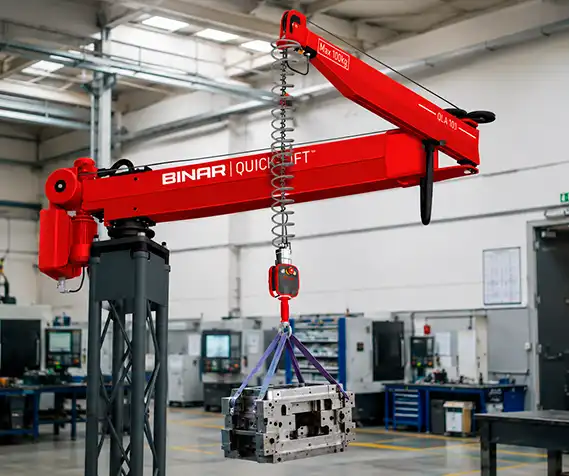
A properly engineered lift assist device removes much of that variation by controlling how the part is gripped, supported, moved, and released.
But simply adding lift equipment is not enough. If preventing product damage is the goal, the system must be designed around the part.
Start With the Contact Zone
The first question should not be, “How much does it weigh?”
Ask:
Where can this part safely be touched?
A quality-focused handling specification should identify:
- Approved and prohibited contact zones
- Maximum allowable gripping pressure
- Surface finish and coating sensitivity
- Part geometry and center of gravity
- Acceptable pad or contact materials
- Areas that cannot support the load
- Oil, dust, moisture, or residue that may affect grip security
This information determines whether the application requires a vacuum, magnetic, mechanical, or fully custom gripper.
The wrong contact strategy can hold the part securely and still damage it. Excessive clamp pressure may leave an impression. A poorly placed vacuum cup may mark a finished surface. A hard contact pad can turn normal positioning into repeated cosmetic rework.
Watch for the Damage That Happens Mid-Motion
Not every defect begins at the gripper.
A part can be held correctly and still shift when the lifting system accelerates, stops, or changes direction. Small jolts—sometimes experienced as “micro-bounce”—can cause the load to settle against a contact point, move inside the tooling, or strike a fixture during placement.
That is why motion quality matters.
The operator should be able to start, stop, rotate, and position the part without fighting the equipment. The lift assist should respond predictably across the full travel path, including the final inches where placement accuracy matters most.
Smooth handling protects both the operator and the product.
Test the System Against Production—Not Perfect Conditions
A clean test part in a controlled demonstration does not prove that a handling system is ready for the floor.
Validate it using actual production conditions:
- Test representative parts, including dimensional and surface variations.
- Introduce the oils, dust, moisture, or other contamination found during production.
- Run the device at the expected cycle rate—not a slower demonstration pace.
- Test at actual operating temperatures.
- Include every required lift, rotation, transfer, and placement.
- Inspect the contact zones after repeated cycles.
- Confirm the grip remains secure during a loss of power or air, where applicable.
- Have production operators perform the test and document their feedback.
The objective is not one successful lift. It is repeatable handling without damage across an actual shift.
Put a Dollar Value on the Defects
Handling damage is often buried across several budgets: scrap, rework, touch-up labor, replacement material, production delays, and customer returns.
Bring those costs together:
Annual handling-defect cost = damaged parts × average total cost per defect
Then compare defect performance before and after deployment:
Annual quality savings = baseline defect cost − post-deployment defect cost
For example, if a workstation produces 30 handling-related defects per month at a total cost of $225 each, the annual exposure is $81,000. Reducing those defects to five per month would recover $67,500 annually—before calculating ergonomic or productivity gains.
That turns the lift assist from a safety-only purchase into a measurable quality investment.
Stop Treating the Handoff Like Dead Space
A zero-defect process cannot include an uncontrolled transfer.
If a finished surface, fragile component, glass panel, composite structure, or painted assembly can be damaged between operations, the handling step deserves the same engineering attention as the processes on either side of it.
KUNDEL develops precision lift assist devices for quality-critical handling around the load, contact points, movement path, production environment, and operator.
Because a part that passes inspection should still be good when it reaches the next station.