

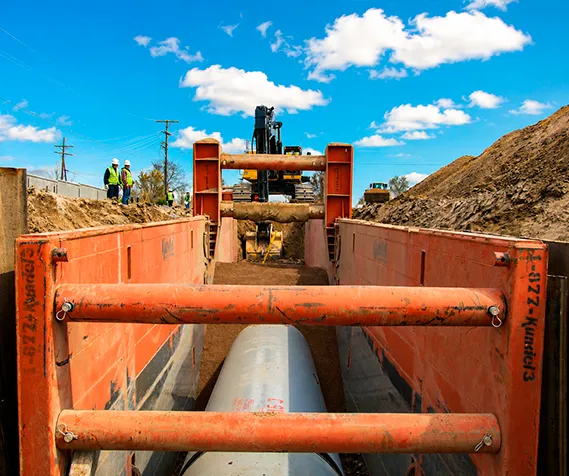
Your crew is inside the trench box. The sidewalls are protected. Everything looks secure.
But what about the open ends?
A trench shield can protect workers from collapsing sidewalls while leaving them exposed to soil falling or sliding into the box from either end.
Trench box end protection is necessary when exposed soil at an open end creates a cave-in hazard that the existing protective system does not adequately address. Depending on site conditions, crews may use properly designed sloping, benching, or an engineered end-protection system.
The goal is simple: Don’t leave an unprotected direction for soil to reach your crew.
Does OSHA Require Trench Box End Panels?
OSHA does not universally require manufactured end panels on every trench box. However, 29 CFR 1926.652 requires employees in excavations to be protected from cave-ins, unless a specified exception applies.
That protection must account for hazardous soil movement from the ends of the excavation, not just the sidewalls.
Under OSHA’s excavation protection requirements, protective systems must be suitable for the anticipated loads and installed according to their approved design.
If an open trench end presents a cave-in hazard, leaving it exposed simply because workers are standing inside a trench box is not adequate protection.
A competent person must evaluate the excavation, soil conditions, and protective system to determine the appropriate solution.
Why Are Open Trench Box Ends Dangerous?
Soil doesn’t only collapse sideways.
Sloughing, the breaking away or sliding of soil from an excavation face, can occur at open trench ends and send material into an otherwise shielded work area.
This is particularly concerning when:
- Crews are working near the end of a shield.
- Excavations have vertical, unsupported end faces.
- Soil is wet, loose, or previously disturbed.
- Nearby equipment or traffic adds surcharge loads.
- Limited space prevents safe excavation slopes.
A protected trench should not contain an overlooked exposure simply because the shield’s two main walls are in place.
How Can You Protect the Ends of a Trench Box?
Two common approaches are properly designed sloping or benching and engineered end panels.
Option 1: Slope or Bench the Trench Ends
Sloping and benching reduce cave-in exposure by cutting excavation walls back to an allowable configuration.
This can be practical on open jobsites with enough available room.
However, allowable slopes depend on soil classification, excavation depth, and the selected OSHA-compliant design. Benching is not permitted in Type C soil under OSHA’s standard Appendix B configurations.
The tradeoff: Sloping requires additional excavation space, which may not be available near roads, utilities, sidewalks, or structures.
Option 2: Install Trench Shield End Panels
Where adequate sloping or benching isn’t practical, engineered trench shield end panels can provide protection against soil movement from exposed ends.
These configurations may include:
- End panels attached to compatible trench shields
- Three-sided trench box arrangements
- Multi-side wall protection
- Modular panels designed for confined excavations
End panels must be compatible with the shield and installed according to the applicable manufacturer’s specifications and tabulated data.
The advantage: Protecting an end with an appropriately designed panel can reduce the need for wider excavation while helping keep workers within the intended protected area.
How Does KUNDEL’s Titan Series Help with End Protection?
KUNDEL’s Titan Series trench shields are designed for demanding excavation applications, including confined work areas where multi-side wall protection may be needed.
Modular Drop-On Panels
KUNDEL offers a Drop-ON attachment that hangs from the shield’s spreaders, giving contractors an additional configuration option without field-fabricating a permanent welded modification.
The appropriate attachment and its suitability for end protection must be confirmed for the specific excavation and shield configuration.
Internal Stacking and Versatile Configurations
Titan Series shields also feature internal stacking points that allow crews to connect compatible stacked shields from within the protected zone, reducing the need to step outside the shield during assembly.
Combined with KUNDEL’s available panel configurations, these features give contractors more flexibility when planning protection for complex excavations.
Explore the Titan Series features and available attachments for additional configuration details.
When Are End Panels Better Than Sloping?
End panels are especially worth evaluating when space is limited and an exposed trench end cannot be safely sloped or benched.
| Jobsite Condition | Protection Approach to Evaluate |
|---|---|
| Open excavation with sufficient space | Compliant sloping or benching |
| Narrow urban street | Engineered end panels |
| Excavation near utilities or structures | Multi-side protective system |
| Confined pit or spot repair | Compatible pit box or end-protection configuration |
An urban location does not automatically make end panels mandatory. The actual requirement is adequate cave-in protection, regardless of the method selected.
Frequently Asked Questions About Trench Box End Protection
Can You Use a Trench Box Without End Panels?
Yes, provided workers are adequately protected from cave-in hazards, including potential soil movement from open ends. Properly designed sloping or benching may provide that protection without manufactured end panels.
Can You Add End Panels to an Existing Trench Box?
Potentially. Any added panel must be compatible with the shield and supported by applicable manufacturer’s instructions, written approval where required, and appropriate design documentation.
What Is a Three-Sided Trench Box?
A three-sided trench box uses protective panels along three sides of a work area. It can be useful in confined excavations where an exposed end requires protection. The remaining exposure must still be addressed as necessary.
Protect the Whole Work Area, Not Just the Sidewalls
A trench box is only part of a safe excavation plan.
Before workers enter, the competent person must evaluate whether open ends expose the crew to falling or sliding soil and verify that the protective system addresses those hazards.
Your crew shouldn’t have to worry about what’s coming from behind them while they’re focused on the work in front of them.
When sloping isn’t practical, the right panel configuration can make the difference between an exposed excavation and a properly protected work area.
Explore the KUNDEL Titan Series to discuss multi-side wall protection, modular attachments, and trench shield configurations designed for your next jobsite.