


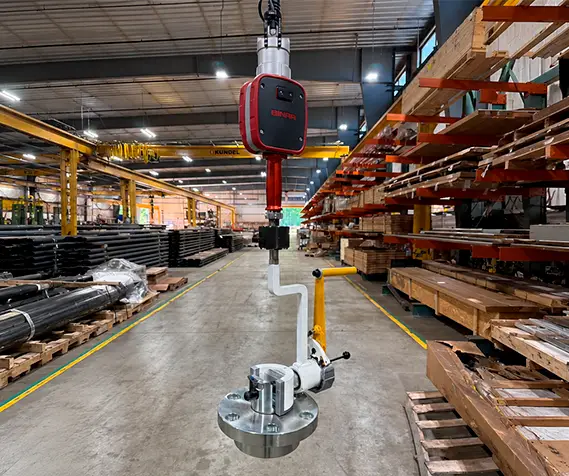
Choosing the right lift assist system starts with one practical question:
How should the equipment actually grip the part?
The crane, jib arm, or balancer moves the load. The end effector secures it. That makes the gripper one of the most important parts of the entire system.
For engineers, procurement teams, and operations managers, the choice often comes down to three common options: vacuum grippers, mechanical grippers, and magnetic grippers.
Each one can work well. Each one can also fail quickly if it is matched to the wrong material, surface condition, or production environment.
This guide breaks down where each gripper type fits best, what can go wrong, and what to include when requesting a quote for a custom lift assist solution.
What Is an End Effector?
An end effector is the tool at the end of a lift assist device that makes contact with the part being moved.
It may grip, clamp, lift, hold, rotate, or support the load depending on the application.
Common end effector types include:
- Vacuum grippers
- Mechanical grippers
- Magnetic grippers
- Hooks
- Custom engineered tooling
KUNDEL builds custom lifting devices for manufacturing and industrial environments where standard lifting equipment does not fully solve the handling problem.
For many applications, the right answer is not just a standard gripper. It is a gripper designed around the part, the operator, and the process.
Vacuum Grippers: Best for Flat, Smooth, or Semi-Porous Materials
Vacuum grippers use suction cups or vacuum pads to hold the part during lifting and positioning.
They are commonly used for:
- Glass
- Sheet metal
- Plastic panels
- Cardboard
- Appliance panels
- Flat or lightly textured parts
Vacuum is often a strong choice when the part has a broad contact surface and cannot be scratched, squeezed, or clamped.
Where Vacuum Works Well
Vacuum grippers are especially useful when the part is relatively flat and the surface can create a dependable seal.
For example, a smooth plastic panel, sheet metal blank, or glass part may be easier to lift with vacuum than with a clamp. The gripper can spread contact across the surface instead of applying force to one edge or corner.
Vacuum can also support faster, more ergonomic handling when paired with lift assist devices for manufacturing.
What Can Go Wrong
Vacuum grippers depend heavily on surface condition.
A clean part may grip well during testing, but production conditions can change the result. Oil, dust, moisture, surface texture, porosity, and temperature can all affect vacuum reliability.
Common vacuum gripper risks include:
- Seal loss
- Part slipping
- Double-picking stacked sheets
- Slow release
- Rotation during movement
Before selecting vacuum, test the gripper on real parts in real operating conditions. Do not rely only on a clean sample from the front office shelf. That sample lives a pampered life.
Mechanical Grippers: Best for Irregular Shapes and Heavy Parts
Mechanical grippers hold the part using physical contact. They may clamp, cradle, pinch, hook, or lock around a part feature.
They are commonly used for:
- Heavy castings
- Machined parts
- Irregular components
- Parts with holes, flanges, lips, or ribs
- Loads that need positive retention
- Parts that cannot rely on suction or magnetism
Mechanical grippers are often the best fit when the part has a shape the tooling can physically capture.
Where Mechanical Grippers Work Well
Mechanical grippers give the most direct control over the load. That makes them useful for heavy or awkward parts where slipping, rotation, or inconsistent orientation creates risk.
A jaw-based gripper may clamp the part from the sides. A finger-based gripper may locate around a hole, flange, or casting feature. A cradle-style gripper may support the part from underneath while another feature prevents tipping.
This is where custom grippers become valuable. The tooling can be designed around the part instead of forcing operators to adapt to the tooling.
What Can Go Wrong
Mechanical grippers are not automatically safer just because they clamp the load.
If the jaw force is too high, the gripper can damage the part. If the contact points are wrong, the part can rotate. If the part is oily, wet, or dimensionally inconsistent, the grip may not behave the same every cycle.
Common mechanical gripper risks include:
- Surface damage
- Incomplete clamping
- Part rotation
- Jaw slip
- Binding during release
- Poor fit across part variations
The key is validation. Test the gripper with the heaviest part, the lightest part, the dirtiest part, and the most awkward part. Production always has a goblin part hiding somewhere in the bin.
Magnetic Grippers: Best for Ferrous Metals
Magnetic grippers use magnetic force to hold ferrous metal parts.
They are commonly used for:
- Steel plates
- Steel blanks
- Round steel
- Structural steel parts
- Ferrous machined components
Magnetic gripping can be very effective when the material is compatible and the contact surface is predictable.
Where Magnetic Grippers Work Well
Magnetic grippers are often a strong choice for steel handling because they can pick up parts without jaws, hooks, or suction cups. This can make them useful for flat steel, round stock, or parts where mechanical contact is limited.
They can also be valuable when operators need quick engagement and release during repetitive handling.
What Can Go Wrong
Magnetic grippers only work on ferrous materials. They are not suitable for aluminum, plastic, glass, cardboard, copper, brass, or many stainless materials.
Even with steel, surface condition matters. Paint, scale, oil, gaps, uneven surfaces, and part curvature can reduce holding force.
Common magnetic gripper risks include:
- Reduced grip from poor contact
- Double-picking thin steel sheets
- Rotation from poor magnet placement
- Incomplete release
- Unsafe use on non-ferrous parts
Magnetic grippers should include clear safety controls, such as grip confirmation, controlled release, and lockout features. The operator needs to know the load is secure before it moves.
Quick Comparison: Vacuum vs Mechanical vs Magnetic Grippers
| Gripper Type | Best For | Watch Out For |
|---|---|---|
| Vacuum grippers | Flat, smooth, or semi-porous surfaces like glass, plastic, cardboard, and sheet metal | Seal loss, oil contamination, porosity, double-pick, rotation |
| Mechanical grippers | Irregular shapes, heavy castings, machined parts, and parts requiring clamping force | Surface damage, poor contact points, jaw slip, part variation |
| Magnetic grippers | Ferrous metals like steel plate, steel blanks, and round steel | Non-ferrous materials, poor magnetic contact, double-pick, residual magnetism |
Decision Matrix: Which End Effector Fits Your Application?
Use this as an early selection guide before requesting a quote.
| Application Factor | Best Fit |
|---|---|
| Smooth glass, plastic, cardboard, or sheet material | Vacuum gripper |
| Oily or irregular casting | Mechanical gripper |
| Steel plate or round steel | Magnetic gripper |
| Painted or cosmetic surface | Vacuum or padded mechanical gripper |
| Heavy part with uneven geometry | Mechanical gripper |
| Thin stacked steel sheets | Magnetic gripper with double-pick controls |
| Multiple part styles at one workstation | Custom gripper or quick-change tooling |
| Parts requiring rotation or flipping | Custom mechanical or hybrid gripper |
| Strict allowable contact points | Custom gripper design |
| Integration with a jib arm or balancer | Custom engineered end effector |
Failure Modes to Test Before Approval
A gripper should not be approved because it picked up one clean part in a demo.
It should be approved because it performs safely under the conditions your operators actually face.
Before signing off, test for:
- Slip during lift and travel
- Seal loss or grip loss
- Double-pick
- Rotation or drift
- Surface damage
- Release failure
- Emergency stop behavior
- Performance with oil, dust, coolant, moisture, or heat
- Performance at the required cycle time
This is especially important when the gripper will be used with zero-gravity lift assist devices, where the goal is not only to lift the part, but to help the operator position it with control.
Integration Considerations
The end effector needs to work with the full lifting system.
That includes:
- The lift assist device
- The balancer
- The jib arm or overhead support
- The operator’s movement path
- The pick and place locations
- The weight of the gripper itself
- Any rotation, tilt, or reach requirements
The weight of the gripper must be included in the total lifted load.
For example:
Total lifted weight = part weight + gripper weight + adapter weight
If the part weighs 150 lb and the gripper weighs 35 lb, the lift assist system must be specified around the full 185 lb load, not just the part.
For workstations that need dedicated coverage, a gripper may also be paired with foundationless jib cranes or other workstation crane systems.
What to Include in Your RFQ
A better RFQ leads to a better gripper.
Before requesting a quote, gather the information that tells the real story of the part and process.
Include:
- Part drawings or photos
- Part weight and dimensions
- Center of gravity
- Material type
- Surface finish
- Allowable contact points
- Areas that cannot be touched
- Current handling method
- Pick and place locations
- Required lift height and reach
- Rotation or tilt requirements
- Cycle time target
- Contamination conditions, such as oil, dust, coolant, or moisture
- Available air or electrical supply
- Existing crane, jib arm, or lift assist equipment
- Safety requirements and acceptance criteria
This helps the supplier recommend the right gripper type instead of guessing from a part name.
KUNDEL designs custom grippers for lift assist devices that help manufacturers handle parts safely, consistently, and with less strain on the operator.
If your team is comparing gripper options for a new or upgraded lift assist system, start with the part. The right end effector should make the lift feel controlled before the load ever leaves the table.