


Every OSHA recordable has a backstory.
Before the incident report, before the restricted duty, before the workers’ comp file, there is usually a workstation everyone already knows about.
The lift is ugly.
The reach is too far.
The part has no good handhold.
The operator has to twist just enough to make it risky, but not enough to make anyone stop the line.
That is how many lifting injuries are born. Not in one dramatic moment, but in a hundred small compromises repeated until the body finally sends the invoice.
For safety managers and EHS leaders, the real work is finding those compromises before they become case numbers.
That is where ergonomic lift assist devices matter.
Exhibit A: The “Manageable” Lift
The part only weighs 28 pounds.
On paper, that sounds manageable.
Now add the rest of the truth:
It is picked 400 times per shift. It comes out of a low bin. The operator has to reach forward, turn slightly, lift, rotate, and place it into a fixture at chest height. By hour six, nobody is lifting cleanly anymore.
That is the problem with manual handling risk. Weight is only one witness.
The NIOSH Revised Lifting Equation looks at the full scene: weight, reach, height, travel distance, twisting, frequency, and grip quality. The result is the Lifting Index. When that number rises above 1.0, the task deserves attention.
Not vibes. Evidence.
Exhibit B: The Recordable That Could Have Been Predicted
Most plants have these stations.
The one with the shoulder complaints.
The one that needs two people when production is behind.
The one new employees struggle with.
The one supervisors quietly assign to the strongest operator.
Those are not quirks. They are warning lights.
OSHA’s General Duty Clause expects employers to address recognized hazards that are likely to cause serious harm. Repetitive lifting hazards can fall into that conversation when the risk is known and nothing meaningful changes.
A poster that says “lift with your legs” is not a control.
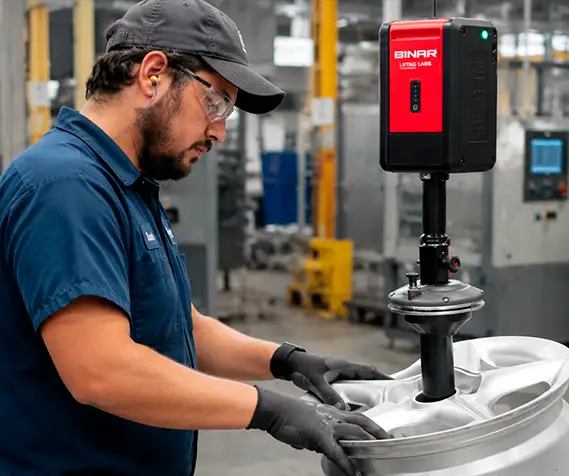
A lift assist device for manufacturing is different because it changes the task itself. It reduces the physical demand instead of asking the operator to keep absorbing it.
What Lift Assist Actually Fixes
A good lift assist system does not just pick up weight.
It removes the fight from the motion.
It can reduce the reach, stabilize the load, control rotation, improve grip, and help the operator move the part without muscling it into place.
That matters because recordables rarely come from “heavy” alone. They come from heavy plus awkward. Moderate plus repetitive. Light plus high frequency. Manageable plus bad design.
When paired with custom grippers for lift assist devices, the system can be built around the actual part: its shape, surface, center of gravity, contact points, and placement path.
That is where injury reduction becomes practical.
Not theoretical. Not motivational. Mechanical.
The EHS Playbook: Start Where the Pain Is Loudest
Do not start with a 40-page ergonomics initiative.
Start with five workstations.
Pick the ones with the most complaints, near misses, fatigue, quality issues, two-person lifts, or injury history.
Then document the task:
- What does the part weigh?
- Where does the lift start?
- Where does it end?
- How far does the operator reach?
- Do they twist?
- How often does it happen?
- Is the grip good, bad, or improvised?
- What changes after the sixth hour of the shift?
Run the RNLE. Get the baseline. Then compare that baseline after the intervention.
That before-and-after data can support OSHA VPP efforts, ISO 45001 documentation, insurance conversations, management reviews, and DART rate reduction goals.
More importantly, it gives the safety team proof that the hazard was not just discussed. It was reduced.
The Best Recordable Is the One That Never Gets Logged
A recordable injury is old news by the time it hits the form.
Someone already got hurt.
Someone already went home in pain.
Someone already became the example in next month’s safety meeting.
Lift assist gives EHS teams a chance to act before that happens.
Find the lift that everyone complains about. Measure it. Fix the motion. Document the change.
KUNDEL builds ergonomic lift assist devices for manufacturers that want to reduce manual handling risk at the workstation level, where the real story starts.
Because the injury is usually in the process long before it is in the log.